ALL ALONE FOR CHRISTMAS
Alone in God’s Home
The unwavering popularity of the Home Alone films (Home Alone and Home Alone 2) is an interesting phenomenon. It can’t simply be the Chuck Jones–style cartoon violence that compels audiences to return to the films well over a quarter of a century after they were first released in 1990 and 1992.
My personal feeling is that, amidst the slapstick and mayhem, there are profoundly religious themes intrinsically tied to the spirit of Christmas—ones that screenwriter John Hughes masterfully tapped into while writing these two beloved festive movies. The Chicago filmmaker had already explored some of these deeper themes of forgiveness, judgment and redemption in earlier films such as Planes, Trains and Automobiles (1987) and Uncle Buck (1989), but I believe he distilled them to perfection by the time he wrote Home Alone and Home Alone 2.
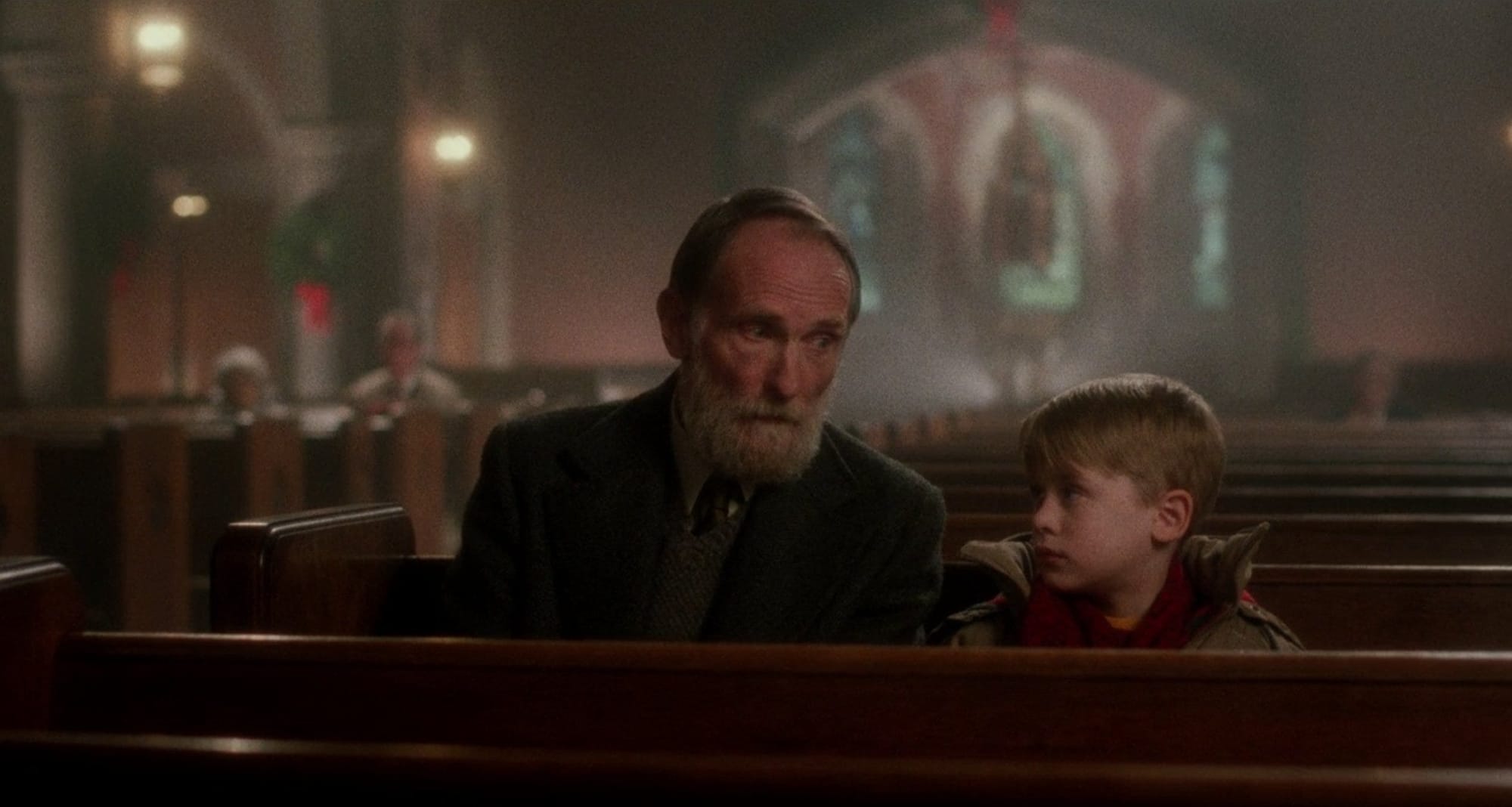
Take, for example, a key scene in Home Alone in which Kevin McCallister (Macaulay Culkin), in his “darkest hour,” decides to visit a local church on Christmas Eve. There, sitting alone among the pews, is Old Man Marley (Roberts Blossom), whom the locals believe murdered his wife. Instead of running away in fear this time, Kevin finds the courage to allow the man to sit beside him. The security of the church gives him reason enough not to flee, for instinctively he senses that a man humbled in a house of God need not be feared—though it is true that Marley’s main reason for being there is to catch sight of his young granddaughter, whom he has not seen for years.
And, of course, once the two of them begin to talk, while the granddaughter and the Christmas choir sing carols by candlelight, the young protagonist soon learns that this is a man who is truly alone at Christmas—an older reflection of himself in some ways, but one whose scars of familial estrangement run deeper, as the precious clock of life edges closer to the grave than his own.
It is a testament to Hughes’s emotional intelligence that he finds the greatest emotional depth between the youngest and oldest characters in the film, uncovering a deeper affinity between them than might have existed had Marley been decades younger. Both are vulnerable for different reasons (though Kevin seems precociously defiant), and both find themselves alone on Christmas Eve in the same church, discovering that they desire the same thing.
Family.
A sense of connection.
Two Turtle Doves
In Home Alone 2, Hughes repeats the trick of the first film, but this time there is no church (unless you count the attic apartment above Carnegie Hall as a church to culture), and Kevin befriends a pigeon lady (who might have her origins in Mary Poppins’ “Feed the Birds” scene) instead of a suspected wife killer, yet happily finds some divergence in the repetition.
Here, the pigeon lady (Brenda Fricker) isn’t seeking a happy ending with whatever she’s run away from. She’ll most likely remain the pigeon lady till her dying days, but in her key exchange with Kevin on Christmas Eve she both finds solace in her connection with a stranger and becomes a temporary mother-replacement figure, helping him when the two escaped robbers, Harry (Joe Pesci) and Marv (Daniel Stern), threaten to kill him. A past of unrequited love and the desire to have children has resulted in her becoming the epitome of the cat-loving bag lady—though with pigeons instead of feline companions as her preferred friends. The sadness in her eyes and the wistfulness of her occasional smile certainly suggests that there’s a lot of pain left somewhere along the path of her life.
But, similar to Kevin, she has a stubborn survival instinct and is happy in her own company. Perhaps they might both be called stoics.
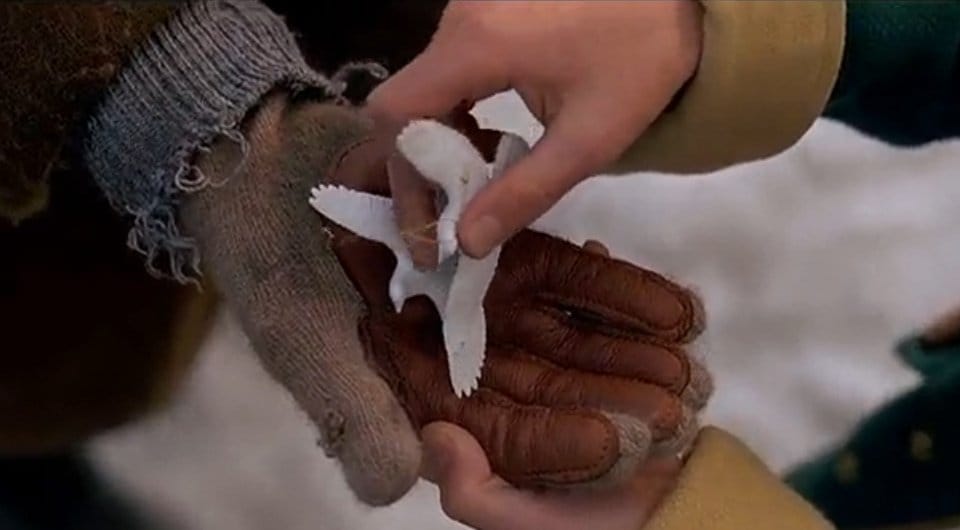
As for Christian imagery in the sequel to the box-office smash original Home Alone movie, there are, of course, the two turtle dove decorations that Mr Duncan (Eddie Bracken) of Duncan’s Toy Chest gifts Kevin as a present when the young boy donates some money to the children’s charity the shop helps provide for. Incidentally, the star on top of the toy tree on the counter by Mr Duncan’s cash register is the same star seen on the children’s hospital that Kevin views from his Plaza Hotel luxury suite window, accentuated by being extra bright—a sort of New York equivalent of the Star of Bethlehem in The Christmas Story.
And, of course, the brightest and biggest tree of all is in Rockefeller Plaza, where Kevin finds himself reunited with his mother on Christmas Eve.
However, we should not forget that Kevin himself is a paradox: both sinner and saint—an antichrist (in regard to the sadistic cartoon violence inflicted on Harry and Marv) with an occasional Christ-like nature (helping Marley, the Pigeon Lady, and the sick children stuck in hospital over Christmas).
Being charitable, one might consider Kevin’s penchant for violence as righteous wrath (if borderline psychopathic), and his inclination to be drawn to the light of the church as proof that he is self-aware enough to “follow the star in his own heart,” meaning to follow the goodness inside himself.