LAST MAN STANDING
The Last Supper
One of the best things about the internet is how casually a random fact can blow your mind while you’re idly scrolling on your phone and rubbing the sleep out of your eyes.
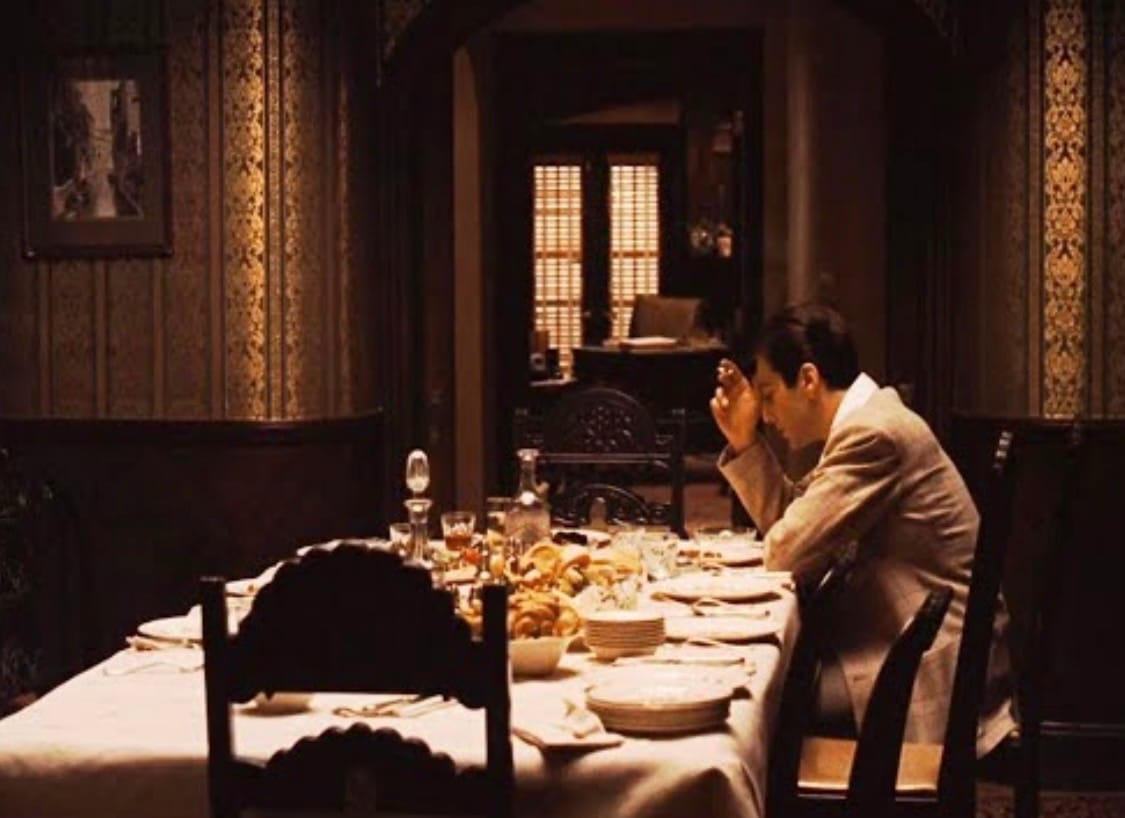
Just this morning, for instance, I came across a Robert Duvall-related post about how the flashback dinner scene at the end of The Godfather Part II (1974) has each of its characters leave the table in exactly the same sequence as the real-life actors playing them have shuffled off this mortal coil — with the exception of Al Pacino, who, at least at the time of writing, is not yet “sleeping with the fishes”.
So, just to break this down: Fredo Corleone (John Cazale, 1935–1978) leaves first, followed by Sonny Corleone (James Caan, 1940–2022), then Tom Hagen (Robert Duvall, 1931–2026), leaving only Michael Corleone (Al Pacino) alone at the table.
That dinner table scene was already powerful enough without needing this extra art-imitating-life angle, which now, after news of actor Robert Duvall’s death, elevates it even further as part of cinema legend.
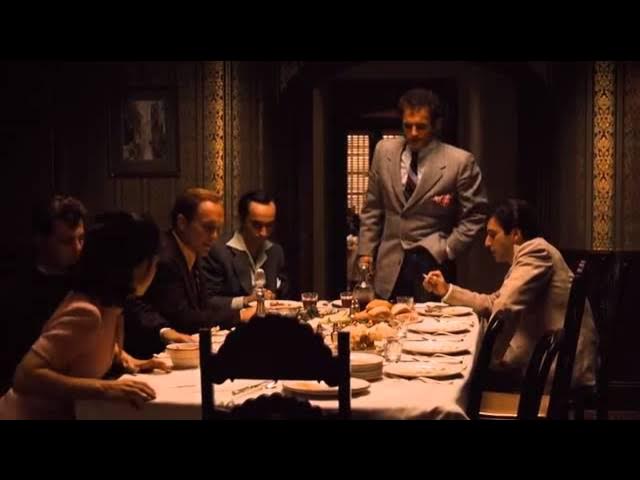
I should also quickly mention how another spine-tingling aspect of this most poignant scene from the second Godfather film is the way the spectre of Brando hangs over it without him ever being in frame. Originally, the scene was supposed to include Brando, but due to financial disagreements between him and Paramount Studios, Coppola had to shoot it without the iconic actor, ingeniously creating a much more poetic and compelling result.
Tom and Michael
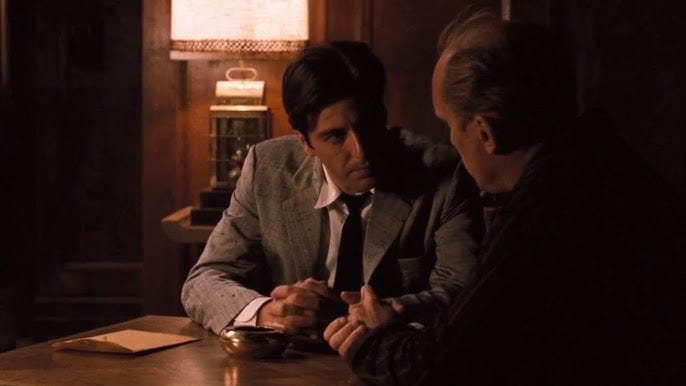
Scenes shared between Tom Hagen (Duvall) and Michael Corleone (Pacino) in The Godfather and The Godfather Part II are, without doubt, among the most powerful in the entire iconic saga of the Italian-American Mafia. At the heart of all their moments together is the ongoing tension between Michael’s unwavering devotion to the blood ties of the family and the loyalty of a street kid (Hagen) adopted into the Corleone family from an early age and who later becomes a sort of surrogate brother to Michael as well as chief advisor to the family under the stewardship of Don Corleone (Marlon Brando).
Initially, as consigliere to Don Corleone in The Godfather, Tom has no reason to feel insecure in his uniquely powerful position. But when events on the ground change quickly after the assassination attempt on Don Vito, the fresh-faced Michael (with the exception of a black eye) emerges to claim the vacant throne and become head of the family, leaving Tom somewhat in the shadows of the operation.
Throughout both films (especially The Godfather Part II), one senses that Michael instinctively knows Tom is the one he should trust most. And yet, due to his ingrained belief in the sanctity of family above everything, he is forced to learn the hard way, through the betrayal of his elder brother, Fredo, a man easily led by outsiders who wish to destroy the Corleones, that it is not always so.
The irony is tragic.
Sonny's Dead
I can’t imagine it being easy to share a scene with Marlon Brando without losing your nerve, but in one crucial scene early on in The Godfather, Duvall manages it in such a way that he almost steals the scene as quietly as a thief in the night.
If anything, one can imagine Brando having to consciously dial down his own mafioso mannerisms to match the quiet, still realism of Duvall’s sublime performance here, in which he has to break the news to Don Corleone that his middle son, Sonny, has been slain in cold blood.
The understatement between both actors here is just perfect, conveyed through tear-filled glances and heavy sighs. Nothing histrionic, just the inarguable finality of death for a character so full of life.
Frankie Five Angels
Another exceptionally powerful scene in The Godfather Part II that Duvall excels in is when Tom Hagen visits caporegime Frankie Pentangeli (Michael V. Gazzo), who is under the FBI’s protective custody at a military detention facility. There, for his own safety, after almost testifying against the Corleone family in a government-led enquiry into the Mafia, he is deemed a traitor and is expected to do the honourable thing and kill himself in order to preserve what remains of his honour.
It’s a moment of calm reflection and mutual respect, which is kind of crazy when you consider it’s a man being told to kill himself because he’s no longer deemed trustworthy by the Corleones. Duvall has to be the most reasonable angel of death ever to visit a dead man walking.
Life and Death
I don’t think I need to write much more about my respect for the late Robert Duvall, other than to say he was a master of stillness and motion in equal measure. One only needs to consider his masterfully understated performance as Tom Hagen, consigliere to both Vito and Michael Corleone in The Godfather and The Godfather Part II, in contrast to his bombastic turn as Lieutenant Colonel Bill Kilgore in Apocalypse Now, where his turbo-macho energy fizzes like a shaken up can of soda, suggesting he has never been happier than in the midst of war.
Duvall’s presence on screen felt certain to convince you that something important was going down. And it’s easy to forget that early in his career he played the silent role of Boo Radley in the 1962 movie version of Harper Lee’s To Kill a Mockingbird. So suitably unflashy was his performance in that film that he might have been a ghost.
Well, now Duvall’s dead, and there’s only one left sitting at that table of legends in the eerie Corelone compound, forever immortalised on the big screen.
Rest in peace, Robert Duvall (1931–2026).