MESSIAHS AND MASKS
IN GOOD FAITH WITH BAD FAITH ACTORS
Groucho Marx once quipped, “I’m not prepared to be a member of a club that’s prepared to have me as a member,” and the polymath Ye, formerly known as Kanye West, seems to inhabit a similar paradox in relation to the church, except his estrangement runs deeper. It is not simply that he suspects he was never fully welcomed into the congregation, but that he distrusts certain pious, self-appointed representatives of the church. He could never quite reconcile the hypocrisy, corruption, and piety that often coexist in these institutions because of such people.
Of course, Ye has always worn his own sins on his sleeve and yet still tries to sincerely engage with God in his life, openly admitting to his numerous flaws, even when they're disguised as braggadocio. In contrast, too many professional Christians promoting the faith refuse to acknowledge their own double standards by similar metrics, so the artist ultimately refutes their authority and answers only to God. Why not? Here is a man who miraculously avoided death in a critical car crash that nearly ended his life. His whole life since that seismic moment has been an afterlife of sorts, living something like Jeff Bridges in Peter Weir’sFearless, whose character, Max Klein, believes himself to be immortal after surviving an air crash.
One glad morning, when this life is over
I’ll fly away
To a land where joy shall never end, oh
I’ll fly away
When Ye was exploring themes of faith in his Jesus Is King era, he spoke about being judged by gatekeepers who tightly guarded their houses of God. Faced with resistance to his own passionate faith, he did not retreat. He replicated. If the church would not house him, he would build his own, a decentralised and aestheticised form of worship in projects like the Sunday Service Choir, where faith became as much performance as devotion.
To some, this looked like a cult of personality, a man mistaking spiritual real estate for personal validation. But Ye’s defence of his vision of faith, implicit or otherwise, rests on a different claim: sincerity is not invalidated by celebrity, and belief does not require absolute purity of devotion. His faith is idiosyncratic and self-authored, but even at his most erratic, he is acting in what he understands to be good faith.
Those guardians of churches and religious organisations who initially embraced his pro-Christian messaging to reach younger audiences ultimately could not reconcile with the all-too-human messiness of the complex artist and man now known as Ye, a figure who is beset by demons and angels in equal measure. And yet, Christianity distinguishes itself through its commitment to forgiveness, offering unconditional opportunities for redemption in the eyes of God. The archetype of the repentant sinner feels especially potent in an era of cancel culture, something Ye knows more about than most after losing major commercial contracts due to a couple of “sleepy tweets” and some weapon-grade exercises in free speech.
What unsettled the institutions that briefly embraced him during the Jesus Is King era was not simply controversy, but inconsistency. They could accommodate the testimony, but not the volatility of the man delivering it. This exposes a deeper tension. Christianity, at its core, elevates the repentant sinner, the flawed individual who returns, again and again, to grace. It is a theology built not on perfection, but on forgiveness.
And still, there appears to be a threshold. Ye became a stress test for that principle.
Like Michael Jackson before him, another celebrity rendered almost otherworldly by fame, scrutiny, and self-mythologising, Ye occupies a space adjacent to belonging but never fully within it. Not cast out entirely, not welcomed completely, but suspended in between.
In that sense, the problem is not that he could not find a home in the church. It is that his presence reveals how conditional that home can be, and how quickly the promise of forgiveness gives way to its limits.
SPACESHIPS AND MASKS OFF
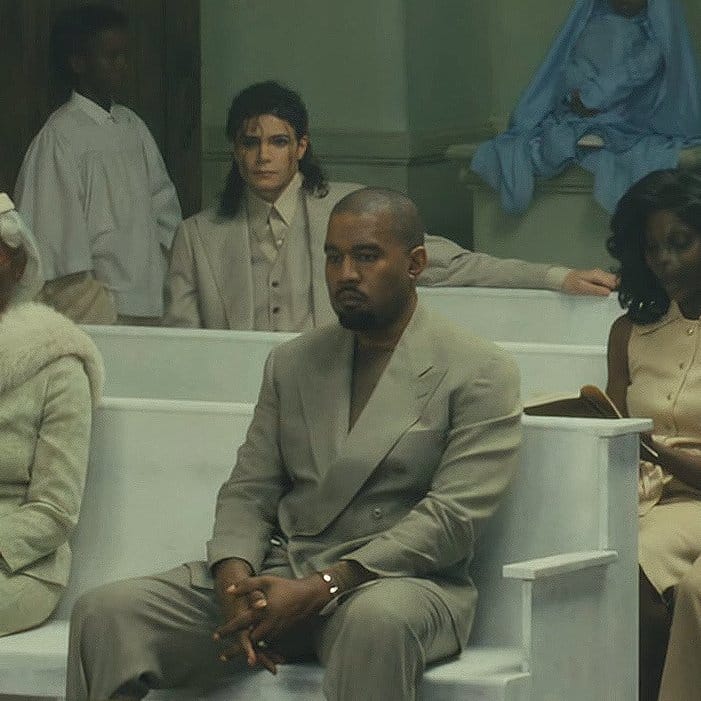
In Ye’s most recent video, Father, directed by his wife Bianca Censori, he appears to sit in a church, but is it even him, or a clone?
The clone theory relating to Ye has been popular in certain corners of the artist's fan community, suggesting he has been replaced by a clone version of himself that acts and looks different from the “real” Ye.
But three motifs have recurred throughout Ye’s career: masks, aliens, and spaceships.
 Digital Renegade
When Kanye’s face is revealed as a mask disguising an alien in Father, it feels reasonable to read this as self-conception: an extraterrestrial, a star man sent from somewhere distant to reflect humanity back to itself.
Recontextualising his existence as an alien helps explain the difficulty of fitting into spaces that cannot accommodate him. Ye has always been the outsider, the Groucho Marx figure reluctant to join clubs once prepared to accept him, whether in hip hop, fashion, Hollywood, or the Church. Those invitations were almost entirely retracted, in part because of his unfiltered way of speaking.
The boy who will not stop speaking out when the bully is in the playground.
And when even the house of God turns its back on you, you might as well be an alien and return to your own lonely planet. There is a suggestion that if God is the father, then the song points to a failed or incomplete reconciliation. If Ye views himself as both child and creator, Father reinforces the isolation of answering only to himself.
This culturally relevant but socially estranged artist figure is compounded by the presence of Michael Jackson watching Ye from a few pews behind his back. Both function as messiah figures in their own way, destabilising the systems, church, media, and culture, that attempt to contain them.
Messiah aliens, even, remaking their identities at the height of their celebrity. Their global fame renders them, at times, almost non-human though while Jackson became increasingly supernatural in appearance, Ye remains reassuringly earthly, surviving his rise and collapse perhaps by being perceived, like Claudius in the Roman dynasty, as a fool.
Perhaps they both belong to a lineage of alienated icons. Jackson might operate as a silent mirror for Ye, a warning about the cost of cultural transcendence and the erosion of grounded identity.
Jackson’s celebrity image existed between admiration and suspicion. His childlike persona, shifting identity, and global fame made him seem almost non-human.
Ye, on the other hand, became too religious for pop culture and too unpredictable for religion. The church cannot fully embrace him, and secular culture cannot fully define him.
Perhaps the ultimate paradox for Ye, as both artist and servant of God, is that the church demands humility and consistency, while celebrity thrives on ego and reinvention. Ye embodies both. That is precisely what makes him incompatible with either.
Sinner/Saint. Artist/Celebrity. Human/Alien.