PERCHANCE TO DREAM
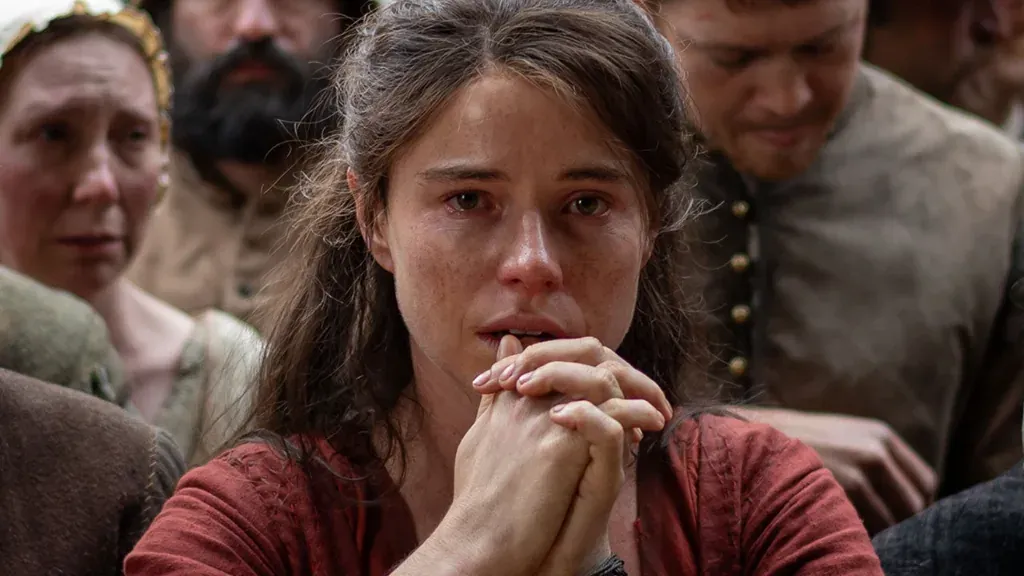
The trouble with mixing history with fantasy concepts is that you can leave the audience feeling duped and manipulated about what is true and what isn’t. Miloš Forman’s Amadeus and John Madden’s Shakespeare in Love doubled down on the fantasy aspects of their projects over any concern for historical accuracy, and yet still found a kind of universal truth in their daring artistic gambles that absolutely paid off. As the newspaperman in John Ford’s The Man Who Shot Liberty Valance says, “When the legend becomes fact, print the legend.”
Conventional biopics are notoriously difficult things to pull off anyway. Most of them fall foul of becoming plodding, linear “Match of the Day” highlights of extraordinary lives, often leaving the viewer desensitised to the seismic events compressed into a two-hour running time. I’ve often thought that taking fragments of extraordinary lives works better, as it allows more space and immersion for the audience to spend time with the subject or subjects at hand. You only need a window to get a view of greatness, not a tour of the entire house. Hamnet suffers because, although it has a singular semi-fictionalised focus on the marriage between Shakespeare and his wife, Agnes, and the heartbreaking tragedy they both endured with their death of their young son, it still feels strangely insubstantial.
Chloé Zhao's Hamnet also disappoints because it doesn’t earn its departures into fantasy from reality and crudely bolts its more outlandish ideas together like some instant cake mix, without any thought given to creating something remotely edible. In the end, it’s a soggy mess of a movie and hard to digest. This is coming from someone who defends sentimentality in films to an almost sadistic point of pride, but the contrived way in which this tale of love, death, and art reaches its emotionally manipulative conclusion—one which producer Steven Spielberg has described somewhat loftily as like being “able to feel the seismic heartbeat of the earth”— ultimately rings hollow.
The symbolism throughout Zhao’s Hamnet is also ham-fisted, including vagina-shaped tree cavities in which the passage between life and death shares a portal similar to the one we see in the forest scene of Hamlet on the stage of the Globe at the end of the film. Early on, Shakespeare (Paul Mescal) clocks the dark void beneath the tree where his wife, Agnes, has given birth and we see how he later converts that image into his “art.” Sadly, this is all too unsubtly telegraphed to be substantially interesting or profound.
Unlike the end of Shakespeare in Love, where Will Shakespeare (Joseph Fiennes) has to say goodbye to Viola (Gwyneth Paltrow) as she leaves for America with Lord Wessex (Colin Firth) and converts the memory of his lost love into the opening of Twelfth Night, Hamnet’s similar attempt to cross the threshold from reality into art suffers poorly by comparison.