SUMMIT MEETING
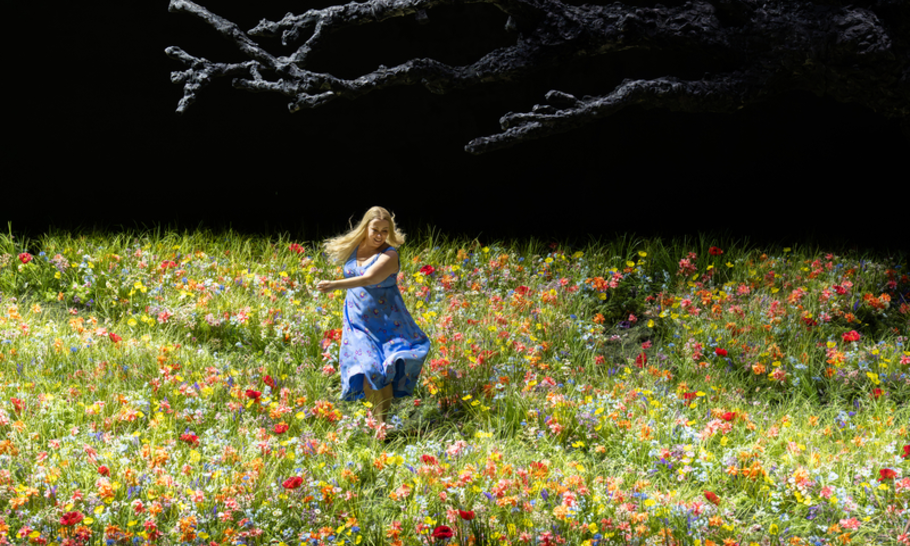
I had completely forgotten that the German composer Richard Wagner (1813–1883) took a 12-year break after completing the second act of Siegfried (the 3rd instalment of his epic Ring Cycle), in which he just so happened to revolutionise music beyond all recognition with his Tristan und Isolde (1865) and disguise his own biography in allegorical form with the luminous Der Meistersinger von Nürnberg (1868).
Returning after his hiatus with Act 3 of Siegfried, it's as if the composer had finally found his way out of the dark, foreboding woods that first appeared at the beginning of Die Walküre (the 2nd opera of the cycle) and which continued through most of Siegfried, until he (like his hero, Siegfried) reaches the summit of a mountain surrounded by a ring of fire where Brünnhilde lies in deep repose.
Similar to the melodic frustration of Tristan und Isolde, it feels as if all the gnarly and knotted entanglements between dwarves, dragons, and gods that dominate Acts 1 and 2 of the opera are suddenly liberated in a musical climax of ecstatic bliss between Siegfried (Andreas Schager) and Brünnhilde (Elisabet Strid) that releases the characters (as well as the audience) from all the pent-up psychological frustration that has suppressed any semblance of joy and happiness up to this point.
We, the audience, much like Siegfried, are emancipated from the industrial-sounding score of the earlier acts and returned into a realm of harmonic delights where it's as if romantic opera has been given a spring clean via a Wagnerian revolution. It makes sense that Wagner designed his score like this, as it charts the story of the primitive Siegfried, who has no real conscious awareness of human emotions or even an understanding of his own past, and is a sort of animalistic non-entity to begin with. It is only after he defeats Fafner the dragon and tastes its blood, accompanied by the cheerful sound of the woodbird (represented in Barrie Kosky's 2026 production by Erda, the earth mother), that he can understand its song (a metaphor for consciousness).
Acts 1 and 2 of the opera are very much the subconscious of the entire cycle, where everything is buried down in the deep, dark recesses of the forest (a representation of the human mind), before Siegfried and the orchestra, with its subterranean leitmotifs, slowly begin to surface with increasing experience and awareness to appreciate the sensory world and all of its terrors and delights.
In many ways, it's the opera equivalent of switching from a box-like 4:3 ratio of old tellies to full cinemascope.
And in the mountaintop, flower-filled meadow where Siegfried and Brünnhilde finally embrace, I found it impossible not to think of Wagner's Good Friday scene from his final opera, Parsifal (1882), in which the hero of the title shares a similar journey of awakening to that of Siegfried, one that begins from the unknowing of things into an increasing awareness of everything around him.
Certainly, there was a tremendous sense of renewal evident in Barrie Kosky's rendering of the scene for his recent Royal Opera production, and given that spring is almost at our own doors, it felt most welcome and energising, and reminded me of that most beautiful chamber piece, Siegfried Idyll (1870), which Wagner adapted from one of the most lyrical passages of the opera. Written on Christmas Day for Wagner's wife's birthday, as she woke to the sound of a string ensemble playing on the staircase below her bedroom, it is far more a reminder of spring than of winter and, along with Mahler's 1st Symphony, is the perfect music to accompany this season of rebirth.
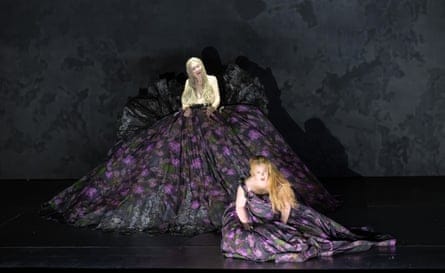
Kosky's endlessly inventive production of Siegfried builds from the many stage motifs established in his previous Das Rheingold and Die Walküre, including the omnipresent, ever-naked Erda (Illona Linthwaite), who silently plays her part in assisting the destiny of the characters, while the increasingly impotent Wotan (Christopher Maltman) resembles a man who is lost between the realm of gods and humans. There will be no happy resolution for Wotan from now on; he will see out his days in Valhalla reflecting on all that he's lost (including his daughter, Brünnhilde) due to his hubristic decisions cast earlier in the previous instalments.
In one especially powerful scene, the silent Erda (earth mother) births a younger version of herself (Wiebke Lehmkuhl), who emerges from beneath her flower-covered dress and engages in an acrimonious exchange with the ever more desperate and volatile Wotan. When the younger Erda returns beneath the silent Erda's dress, once more the cyclical motif of endless return, central to the main theme of all four Ring operas, is eerily demonstrated.
In Paul Schofield's book The Redeemer Reborn, he suggests that Wagner's final opera, Parsifal, is in fact the unofficial fifth opera of the Ring Cycle, and that the holy fool of the opera's title finally liberates himself and others from the endless cause and effect suffered through unconscious attachment. It's a Buddhist idea that Wagner may have found inspiration for in the works of Schopenhauer, but one that makes a great deal of sense when you consider that, by the end of the Ring Cycle, the only victor is not gods or humans, but nature itself.
Parsifal changes that through empathising with the suffering of others. By the time of Siegfried's death in Götterdämmerung (Twilight of the Gods), the naive hero has not yet thought beyond his own love of Brünnhilde to imagine a greater truth, like that of Parsifal.
Still, on that flower-covered mountaintop, he has yet to know of his tragic fate. And while we experience his feelings of love for Brünnhilde, we become lost in his and Brünnhilde's passion, the consequence of what is yet to come in the epic tale a distant threat.
For now.