BIG HAT, NO CATTLE
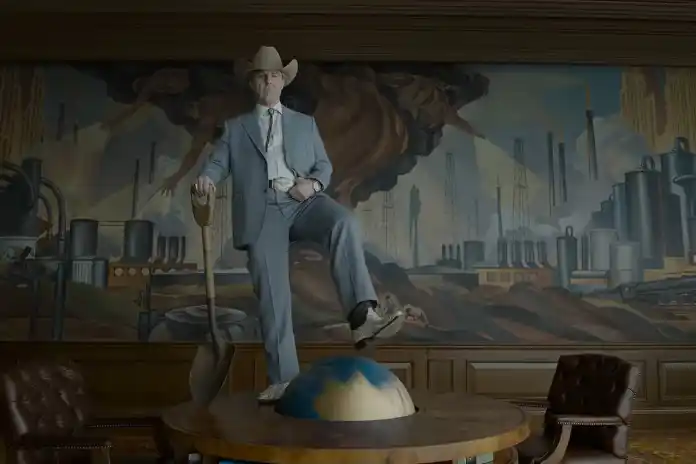
Big hat, no cattle
Big head, no brain
Big snake, no rattle
I forever remain
Big hat, no cattle
I knew from the start
Big boat, no paddle
Big belly, no heart
Randy Newman, "Big Hat, No Cattle"
It's hard to deliver truly great satire to audiences if the underlying ideology that informs its premise reveals its obvious bias by the final reel. The real trick in satire is to be wholly universal (keeping one's own politics like a sleight of hand, a mystery) and laugh at all comic misfortune, black or white, male or female, rich or poor, as Sir John Falstaff and company do in the final fugue, "All the World's a Jest", in Verdi's operatic version of Shakespeare's The Merry Wives of Windsor. If the idea that "all the world's a stage" is a crucial part of Digger's concept, then it seems as if Iñárritu wishes to rip up the constructed stage of art and chastise audiences for wasting their time watching fake representations of it before their eyes when reality beckons them to do something about our real-world stage in peril. How very Greta Thunberg of him. However, if the central thesis is that satire in the 21st century is dead and ultimately unhelpful, then isn't Iñárritu's $180 million disaster movie a futile gesture in itself, an example of a type of creative arrogance that ends up eating itself conceptually in order simply to pollute the Earth with more unnecessary content?
For such a hefty budget, Digger itself sure has a considerable carbon footprint of its own, though perhaps it will offset that by the lack of people showing up to watch the movie. As it stands, the film is reported to have made an overall loss of $250 million. How would Digger dig himself out of this one? Perhaps, if the entire film had been a deliberate satire on the irrelevance of making money in a society with no value, then perhaps it would have been a stroke of genius à la Max Bialystock, but sadly, I fear Iñárritu's Kubrick complex has finally defeated him.
The Mexican director might instead have considered making an earnest global warming documentary with an experimental soundtrack and having Tom Cruise narrate, with great Ethan Hunt earnestness, the eco-disasters we face or are facing. Perhaps Cruise himself might have made more of an impact in raising awareness about the climate apocalypse by incorporating a global warming storyline into his Mission: Impossible franchise. He would have had a captured audience, after all.
Because who, in the end, will enjoy Digger, an empty gesture of satire if ever I saw one? Probably the same people who tried to convince us that The Revenant was more than simply an arthouse Liam Neeson survival movie shot at magic hour. Spoiler alert: it wasn't.
Art, even at its most despairing, should offer some catharsis, but here, in Digger's confused jumble of ideas, we sit in the dark feeling as if a team of writers have been furiously masturbating their minds in front of us in order to say something, anything profound and original, which only comes across as juvenile posturing. Perhaps Digger truly is the cinematic equivalent of Fukushima's End of History prognosis.
"If it bends, it's funny. If it breaks, it isn't."
Lester (Alan Alda), Crimes and Misdemeanors (1989)
It was the late American cartoonist Scott Adams who once observed that "comedy is dead", partly because reality and the world itself had become so absurd that it more than supplied enough jokes. If reality has already become so much of an absurdist spectacle, then what exactly does another $180 million worth of manufactured absurdity add to it? And if the world itself has become the joke, perhaps the real challenge for the satirist is no longer to invent increasingly elaborate absurdities in order to add to the confusion of these times, but to find some smart and, yes, cathartic new way of making sense of the absurdity that is already in front of us.
"Okay, so you guys may be the first to shoot a man to the moon, but if he wants a Coke on the way, you'll have to come to us." - C.R. MacNamara (James Cagney), One, Two, Three (1961)
Leaving the cinema after watching Digger, I couldn't help thinking about the genius of Billy Wilder's One, Two, Three(1961) [three years before Kubrick's Dr. Strangelove (1964)] and how supremely confident it was in satirising East and West Berlin during the height of the Cold War, with James Cagney as C.R. "Mac" MacNamara, the fiery head of Coca-Cola's West Berlin operation, who dreams of promotion to London while plotting to get Coke into the Soviet market. He is the comic embodiment of American capitalism, charging around a divided Berlin with the manic energy of a man who sees the Cold War not as an ideological struggle but as just another market opportunity for Coca-Cola. When his boss's daughter falls for an East German communist, MacNamara finds himself frantically trying to protect his career by manipulating both sides of the political divide, and Wilder has the confidence to make everyone look ridiculous. Capitalists, Communists, Americans, Germans, Russians, even Coca-Cola itself, all become targets. The joke is never allowed to settle comfortably on one side of the political fence. Cagney's MacNamara is both the engine of American commercial expansion and its most absurd caricature, a man who can look at a divided city and see only dollar signs.
In Wilder's world, the entire world is farce and we're all players in it, so, to paraphrase MacNamara, why not have a Coke as we face our civilisational collapse?
Perhaps Iñárritu should lighten up a bit and have a Coke before he attempts another farce/satire/whatever.