RIEU THE DAY
When ex-firefighter and Labour unionist Paul Embery, now laughably regarded by the easily offended as a right-wing commentator, tweeted a battle cry about why Western Christian culture is “still worth saving”, he might have considered whether posting a clip of André Rieu and his orchestra was the best example to hold up in support of his argument, his “Roman Empire”, so to speak.
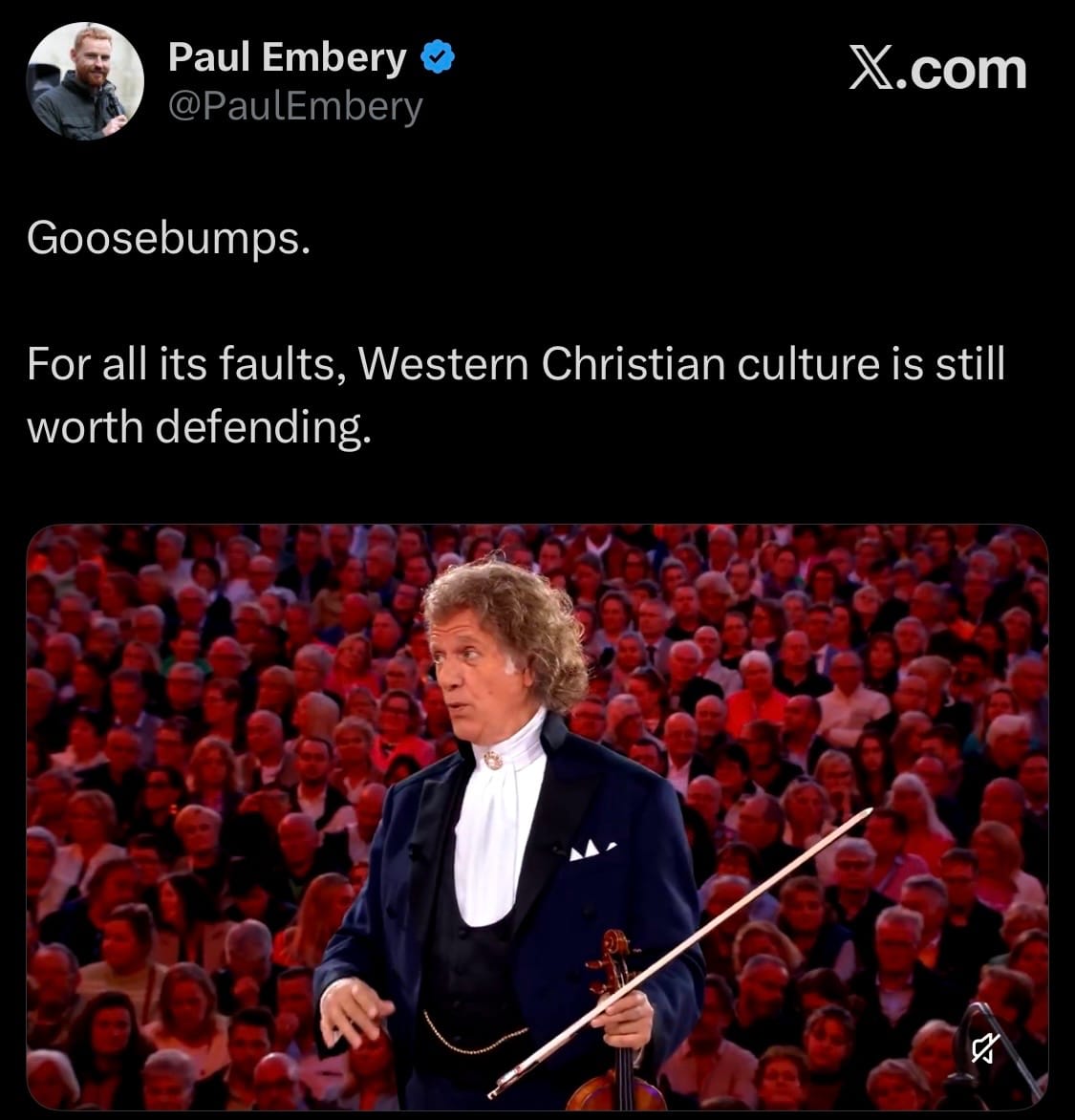
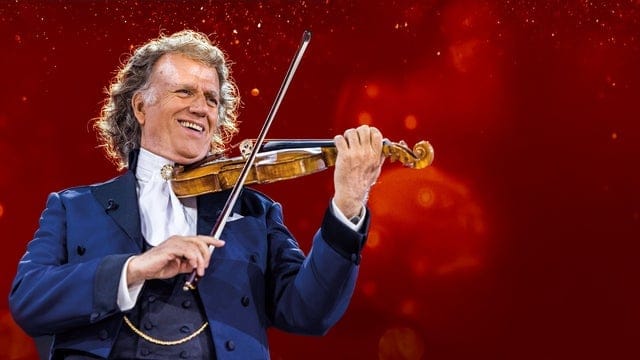
Embery’s shared clip of conductor Rieu, who resembles someone lost in time, like Kaspar Hauser crossed with a European porn star/part-time hairdresser from the 1980s, is hilarious (unintentionally, on Embery’s part) because of the sheer kitsch of the performance, with many of the orchestra players dressed in outfits that look as though they might have been borrowed from the Disney Princess section of a down-on-its-luck costume shop. Close-ups of teary-eyed audience members listening in rapt awe to a performance of “Nearer, My God, to Thee” in Vrijthof Square, Maastricht, only add to the bizarre spectacle.
But André Rieu’s success is no accident. For decades, Rieu has built an enormous international audience by turning orchestral music into a lavish theatrical spectacle, with a deliberately sentimental presentation of the classical repertoire. Rieu’s appeal is less about being an austere gatekeeper of a grand tradition of music-making and more about getting as many punters through the gate as possible to share in some form of cosplay classical music-making and collective emotional catharsis.
And this is where the schism between what is perceived as high art and low art becomes more interesting than the obvious comic derision. Rieu may be an aesthetic horror to the classical-music snob, but the extraordinary scale of his audience raises an awkward question: if he is introducing millions of people to orchestral music, how much should we care that he does so through the cultural equivalent of a chocolate box?
Subsequently flooded with reposts by his more cultured comrades on the left and cultural puritans on the right, Embery found his feed awash with angry exemplars offering far weightier cultural alternatives than the Dutch Liberace, whose global success continues to baffle the cultural intelligentsia.
Swarthy Swabian declared angrily: “André Rieu is the gas-station sushi of orchestral music. Could you fucking chuds at least try to engage with the culture you claim to defend?”
Meanwhile, Ads stated: “Could the steadfast defenders of Western Christian culture stop highlighting their lack of taste by glazing the musical equivalent of a Rustler burger?”
And Edmund offered a rather different response:
“I’m sorry, but this is where goosebumps come into play.
J. S. Bach, Mass in B Minor, Dona Nobis Pacem (conducted by John Eliot Gardiner).”
The reaction is revealing because it turns a question about cultural transmission into a question of cultural taste. Here is the proper stuff, the serious stuff, the stuff that supposedly demonstrates that one really understands Western civilisation. Bach rather than Strauss. Solemn Gardiner rather than Rieu’s Maastricht spectacular. The sacred canon rather than the classical-music equivalent of a live jukebox.
One might suggest that Rieu is the populist deity of classical music, performing a sort of last rites for miniatures, waltzes and movie soundtracks, accompanied by a horde of special guests who could have been assembled from a creepy funfair.
Here, perhaps, is where the dreams of Europe go to die.
In many ways, the concept of the West currently sinking like the Titanic finds a perfect metaphor in its being led by Rieu’s baton: a ghostly and ghastly echo of the great, exalted classical works of the past, reduced to the consistency of wet, scented toilet paper.
Of course, seeing ironic counter-posts featuring videos of Cilla Black singing some awful, forgotten pop song while wearing a black leather jacket that had previously been relegated to hell, Paul Shane performing a mock rock ’n’ roll number, or Michael Barrymore riffing on Coolio’s “C U When You Get There”, and claiming that these too are worthy of being considered pillars of Western civilisation, is all hilarious shitposting.
But some part of me, deep down, urges caution.
As a self-confessed classical-music snob who finds Rieu to be the classical-music equivalent of the Child Catcher from Chitty Chitty Bang Bang, I have no great reason to defend him or his bizarre concerts, which elicit such fierce, misty-eyed emotion from those who attend. But I do wonder whether, in taming savage beasts, we shouldn’t be quite so dismissive of the form Orpheus takes.
There is something slightly peculiar about the assumption that cultural preservation must always arrive in an aesthetically respectable package. Perhaps the person who encounters Beethoven in a solemn concert hall is engaging with the tradition in one way, while someone else might first encounter the broader world of orchestral music through a vast outdoor spectacle, a Strauss waltz, a familiar film theme and a sea of illuminated dresses. The routes into a cultural tradition need not all look the same. One may be more sophisticated than another, but sophistication and cultural engagement are not necessarily the same thing.
Indeed, the snobbery directed at Rieu contains an uncomfortable paradox. If the problem facing Western culture is that fewer people are familiar with its artistic inheritance, then sneering at one of the people who has managed to turn orchestral music into a mass spectacle may be a strange way of defending that inheritance. It is perfectly possible to think Rieu is dreadful and still recognise that his success tells us something important about the appetite for the very culture his critics claim to be defending.
Perhaps this is the uncomfortable lesson of the whole spectacle. Orpheus, the legendary musician who could charm even the natural world with his music, was supposed to lead the dead back into the light. Nobody ever said he had to look or sound the way the cultural guardians expected him to in order to do so.
Surely, beggars can’t be choosers in the current state of gloom in the West these days.
Meanwhile, Embery’s tweet has already earned more than 14 million engagements.