SOUL SHUCKER
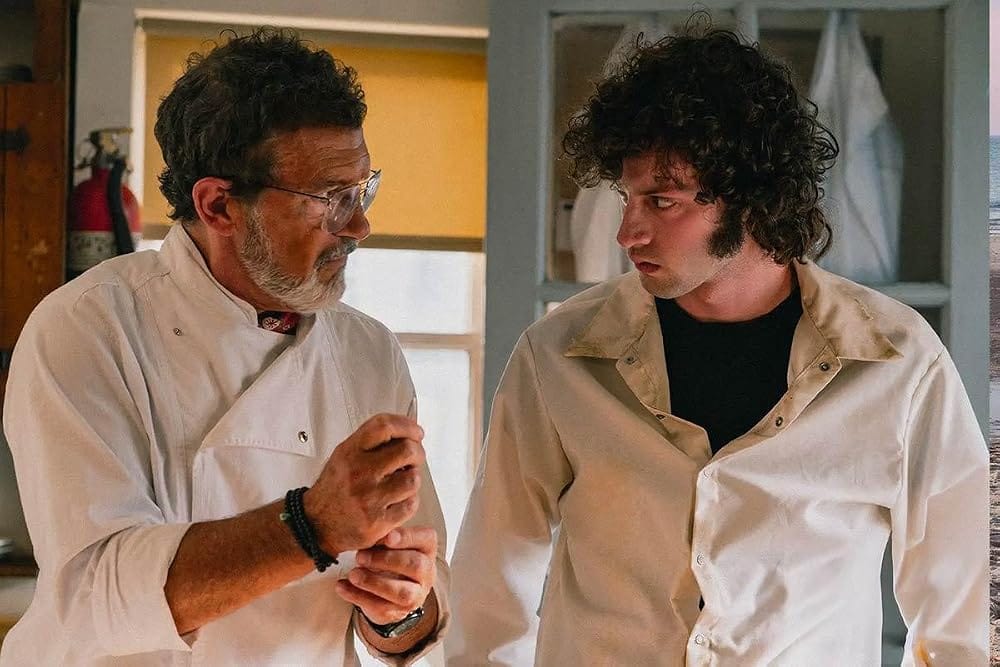
Maybe it was the location of Provincetown, Cape Cod, that instantly seduced me while watching the Anthony Bourdain biopic Tony (2026), where memories of Amity in Spielberg's Jaws came to mind, but even more than that was the effortlessly charming supporting performance of Antonio Banderas as Ciro, an older man who knows his limitations in contrast to the younger man, Tony (Dominic Sessa), who has yet to find them.
Tony is a coming-of-age tale, one similar to the one that Bourdain himself in the movie is trying to pitch in order to secure a literary fellowship so that he can write the great novel. The dichotomy between writer and chef sits at the heart of the title character, one who is inadvertently seduced into the world of sweary, sweaty chefs snorting coke off their wrists while grilling lobsters and shucking oysters but who also wishes to be the next J.D. Salinger.
Matt Johnson's movie has a little more depth than Garry Marshall's The Flamingo Kid (1984), another classic coming-of-age summer movie, but not too much psychodrama that it becomes morose in attempting to frame the grim tragedy to come later for Bourdain. Besides, a film that focused on trying to prise open the darkness that lurked at the centre of Bourdain's conflicted soul might have needed too much supposition to achieve that goal. This film celebrates the boy becoming the man in a light and breezy way that feels as fresh as oysters and ocean spray and is all the better and more human for it.
One foreshadowing of Bourdain's suicide might be inferred from a portrait that hangs in Ciro's kitchen at his restaurant, The Flagship. The salty sea chef points to a picture of François Vatel, the 17th-century French chef who famously killed himself after the fish for a banquet for King Louis XIV failed to arrive on time. Death and suicide seem a million miles away from the young Tony's mind at this point, but there are hints of a sadness behind his avoidant eyes that suggest a reckoning may one day yet come.
Sessa's performance is formidable and manages to be so much more than an impression or caricature of Bourdain. The use of his eyes to convey a young man drinking in his new surroundings and the people who inhabit them is brilliantly done. We can see the whirring of his writer's brain, clocking every detail for some future book, no doubt Kitchen Confidential. He is as much a photographer with his eyes as the girl he fancies, Nancy (Emilia Jones), is with her camera.
Another fascination for me watching Tony was to see how others adapt a kitchen story for the screen, having attempted to dramatise my brother's life in hospitality through the 90s in a television pilot episode entitled "The Dumb Waiter". My brother started out as a maître d' par excellence, learning silver service under the tutelage of Nico Ladenis' team as a late teenager and later going on to work in the Queen's Restaurant on the QE2 cruise ship and run several West End restaurants as general manager. Having watched him operate every permutation of a restaurant, from the front of house to the kitchen (he now works as a chef), there were recognisable tropes in Tony but also, for me, the precocious kid who thinks he can be a writer just like that. My brother has also had shades of the more volatile Sal (played by Leo Woodall) and the world-weary pragmatism of Banderas's Ciro. I guess when you start out as a pot wash and end up the boss of everyone else, you feel as if you've lived every piece of the restaurant chess board.
I thought of him watching the film, seeing so many aspects of his own personality reflected in so many of the characters, having lived a life in restaurants around the globe.
Now I think about it, remembering one time we carried bin bags full of lobsters through London to get back to our family home in Gloucestershire before the ice melted so we could throw them into pans of boiling water seems like a scene straight out of the pages of Bourdain's Kitchen Confidential.
Seeing the many lobsters being prepared in Tony brought that funny memory back to me, as did that warm, wistful end-of-summer feeling that always works so effectively for demonstrating that vital passage of time for all of us when we're younger.
Tony is a film that captures that beautifully and, in so doing, pays the warmest tribute to its deceased subject.
A special mention, too, for the score by Jay McCarroll, which seems to repeat a sort of bell buoy motif, with subtle use of accordions to reflect the seaside atmosphere of the story.